Lean Six Sigma Consulting for Small and Mid-Size Businesses
Your team isn't failing because they're not working hard enough. They're failing because the process they're working in has never been designed to succeed. Lean Six Sigma finds where that process breaks, proves it with data, and fixes it for good.

The process they're working in has never been designed to succeed.
Lean Six Sigma changes that.
Signs Your Business Has a Lean Six Sigma Problem
You don't need to know the terminology to recognize these patterns.
Waste signals
- Jobs regularly take longer than they should, even when nothing goes wrong
- Your team is always busy but output doesn't match the hours
- Customers have to follow up repeatedly to get answers or status
- Information gets passed between people and something always gets lost
Variation signals
- The same job gets done differently depending on who's doing it or what day it is
- Rework is a normal part of your process — you're regularly fixing things before they go out
- Quality complaints are inconsistent — sometimes perfect, sometimes not
- You've 'fixed' the same problem more than once
If three or more of those sound familiar, Lean Six Sigma is almost certainly the right tool — not because it's a good idea in theory, but because these symptoms have a specific cause that LSS is designed to diagnose and correct.
The DMAIC Framework
How Lean Six Sigma Actually Works
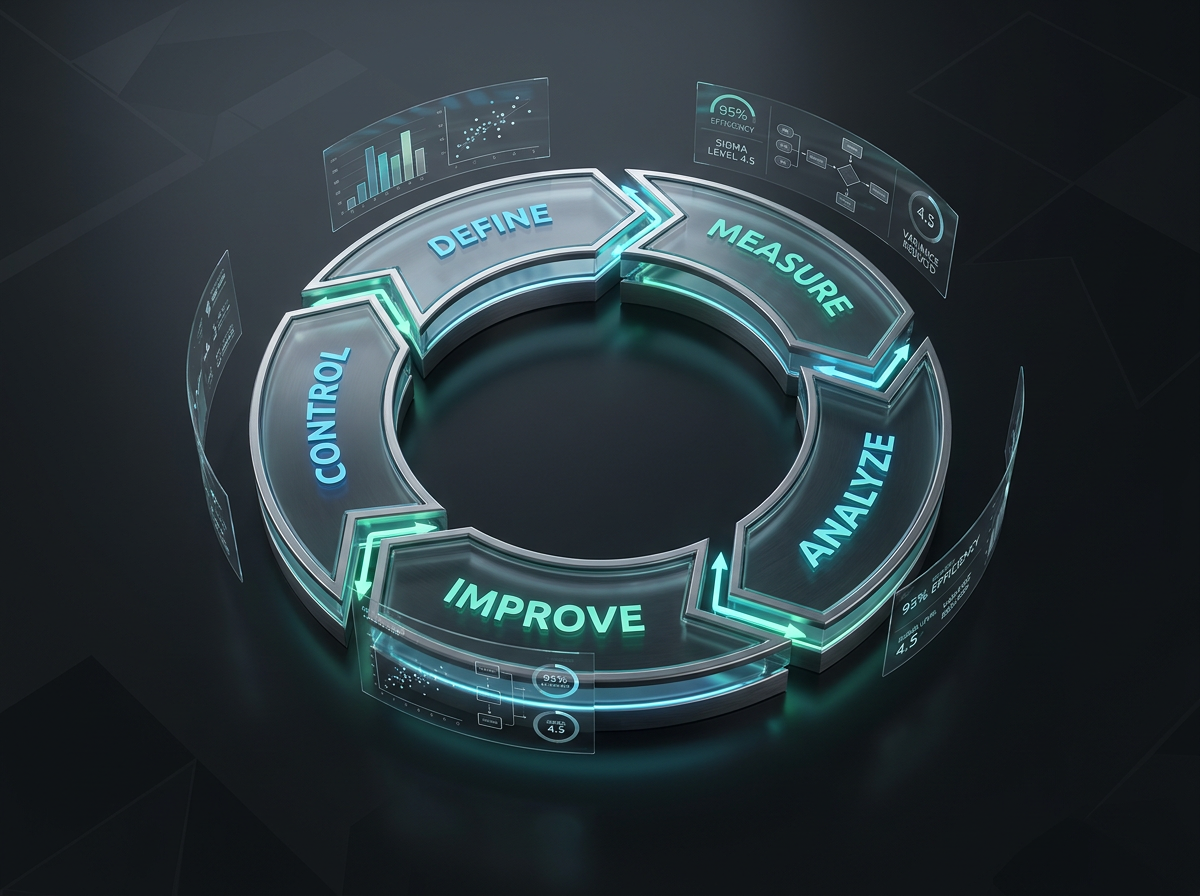
Five phases. Each one builds on the last. No shortcuts, no guessing.
Define
What Are We Actually Trying to Fix?
Most organizations think they know what their problem is. Often they know the symptom and are guessing at the cause. The Define phase forces precision: we identify the specific process that's underperforming, establish who the customer is, and write a problem statement based on observable facts — not opinions. This alone often clarifies things for teams that have been vaguely frustrated for months.
Measure
What's Actually Happening?
Before proposing any solution, Accuvae establishes a baseline — cycle time, defect rates, error frequency, wait times — using actual data from your operation. This prevents the extremely common mistake of solving the wrong problem, and it creates the before-and-after comparison that makes improvement provable. Without a baseline, you're guessing whether you got better.
Analyze
What's Causing It?
Using structured tools — process mapping, cause-and-effect analysis, data stratification — we identify the actual source of the defect or waste, not the most obvious explanation. The thing that looks like the problem is frequently a downstream effect of a process design failure. Solving the root cause produces lasting improvement. Addressing symptoms produces temporary relief.
Improve
What Do We Change?
Once the root cause is confirmed, we design and test improvements — using Agile sprint cycles to test changes with real data before committing to full rollout. Changes are documented in plain operational terms that your team can follow and train new hires from.
Control
How Do We Make Sure It Stays Fixed?
The most neglected phase. Without control mechanisms, organizations improve a process and then gradually drift back within six months. Accuvae builds measurement checkpoints, simple dashboards your team can monitor, and clear protocols for what to do if the process starts to slip — so the improvement survives after the consultant leaves.

Clean processes. Consistent results. No single point of failure.
A Natural Combination
Lean Six Sigma + AI
Lean Six Sigma finds and eliminates the waste in your current process. Once the process is clean — standardized, consistent, and measurable — it becomes dramatically easier to automate. Automating a broken process just makes the errors happen faster.
Many Accuvae engagements begin with LSS work and evolve into AI implementation once the underlying process is ready. This sequence is often the highest-ROI path.
Related Service
AI Consulting for Small Businesses →
Automate what LSS cleans up. Identify the highest-ROI automation targets in your now-optimized process.
FAQ
Lean Six Sigma FAQs
Ready to Find Out What Lean Six Sigma Can Fix?
The assessment call is free and takes 30 minutes. Sean will identify whether LSS is the right approach and tell you honestly what the scope of work looks like before you commit to anything.